
Medinet Habu Temple | The Majestic Mortuary Temple of Ramses III in Luxor
Medinet Habu Temple, also known as the Mortuary Temple of Ramses III, stands proudly on Luxor’s West Bank as one of the most exquisite and best-preserved temples from ancient Egypt. While Luxor dazzles visitors with legendary sites such as the Valley of the Kings and Hatshepsut Temple, Medinet Habu offers something remarkably unique—vivid color, deeply carved inscriptions, towering pylons, and an atmosphere that feels almost untouched by time. It is a site where pharaonic history, military power, religious traditions, and architectural magnificence come together in a perfect blend.
For travelers seeking a deeper connection to Egypt’s ancient heritage, this temple is not just a stop on an itinerary—it is an immersive experience. Its walls tell stories of war, devotion, festivals, and royal pride. Its structures reveal the architectural genius of the New Kingdom. And its peaceful surroundings offer a serene escape from the crowds. In this comprehensive guide, you will learn everything you need to know about Medinet Habu Temple—from its history and significance to what exactly makes it one of the most extraordinary monuments in Luxor.
The Historical Legacy of Medinet Habu Temple
The Reign of Ramses III: A Pharaoh in Turbulent Times
Ramses III, the pharaoh responsible for constructing Medinet Habu, ruled during Egypt’s 20th Dynasty. He is often regarded as the last great warrior king of ancient Egypt. During his reign, the country faced multiple threats, including invasions by the Sea Peoples, internal economic pressures, and political complications. Despite these challenges, Ramses III maintained Egypt’s stability and military dominance through strategic campaigns.
To commemorate his victories and secure his eternal legacy, he commissioned the construction of his mortuary temple at Medinet Habu—a grand complex that would serve both as a religious center and a memorial to his power. The temple not only honored Amun, the chief deity of Thebes, but also preserved Ramses III’s name and achievements in stone for all eternity.
.jpg)
Why the Temple Was Built
Mortuary temples played a crucial role in ancient Egyptian belief. They weren’t tombs but sacred spaces built to maintain a pharaoh’s memory and ensure his eternal life by providing offerings, rituals, and prayers. Medinet Habu was designed for exactly this purpose. Priests would perform daily ceremonies, festivals, and rituals dedicated to Ramses III and Amun-Ra. The temple also served as a governmental and economic center, acting as a massive estate with agricultural fields, workshops, and residential areas for workers and priests.
The Architectural Splendor of Medinet Habu
A Massive and Highly Fortified Temple Complex
Medinet Habu is one of the largest temple complexes on the West Bank of Luxor, second only to Karnak Temple in sheer size. The temple’s enclosure wall is enormous and resembles a fortified structure, giving Medinet Habu a unique appearance not found in other temples. This massive mudbrick enclosure once protected administrative offices, storage rooms, and residential areas.
The First Pylon: A Colorful Welcome to Ancient Egypt
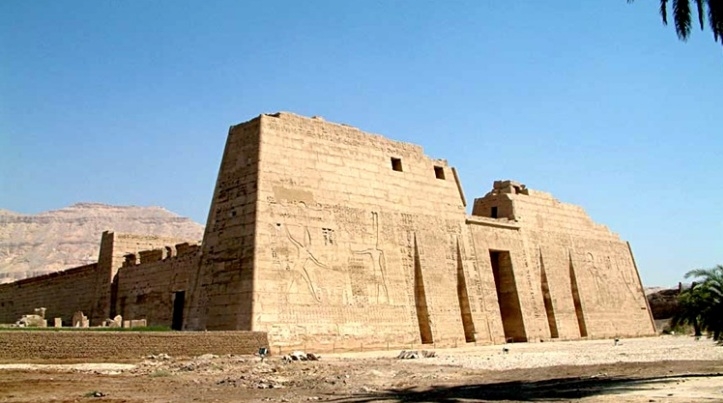
As visitors approach the temple, the first pylon stands tall and commanding. Remarkably, many of the original colors are still visible—especially shades of deep blue, red, ochre, and turquoise. The reliefs on the pylon depict Ramses III smiting enemies while being blessed by Amun. These carvings vividly recount the king’s victories over the Sea Peoples, one of the most significant and well-documented battles of his reign.
The Oriental Gate: A Syrian-Style Architectural Influence
The unique rectangular tower known as the “Migdol Gate” or Oriental Gate is one of Medinet Habu’s most striking features. It was inspired by Syrian fortresses and shows strong foreign architectural influence. The gate once served as a watchtower and even housed royal apartments. It offers historians insight into the multi-cultural interactions of the New Kingdom.
The Courtyards: A Journey into the Sacred Complex
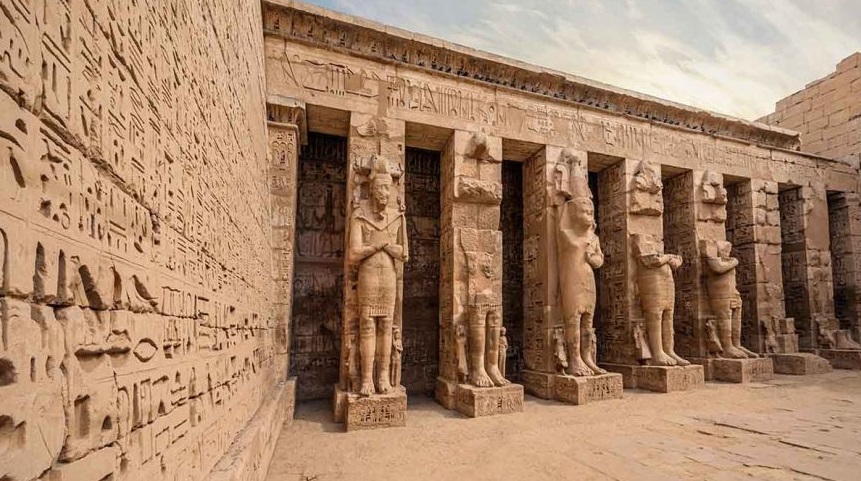
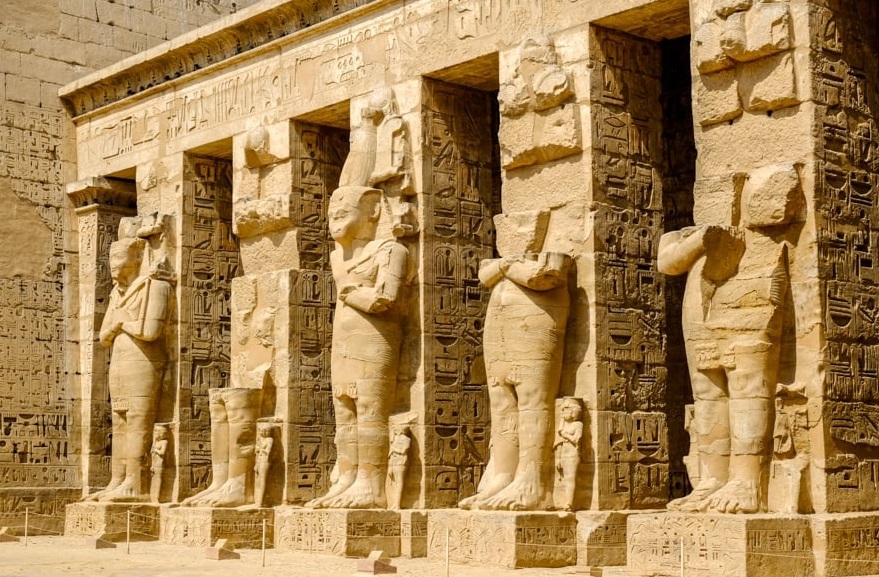
After the pylon, visitors enter the spacious First Courtyard, a stunning open area surrounded by colossal statues of Ramses III and rows of painted columns. This space was used for major rituals and festivals.
The Second Courtyard, even more impressive, contains some of the best-preserved reliefs in Egypt. Here you can see the famous “Feast of Min,” a celebratory scene honoring the fertility god. The vivid depictions of priests, dancers, musicians, and offerings showcase the artistic finesse of the 20th Dynasty.
The Hypostyle Halls: Where Light Meets Sacred Shadow
Deeper inside the temple lie two hypostyle halls filled with columns adorned with hieroglyphics and divine imagery. Although some sections of the roof have collapsed, the remaining pillars and inscriptions maintain an atmosphere of ancient sanctity. The dim lighting inside creates a dramatic contrast with the brightness outside, enhancing the spiritual experience for visitors.
The Holy of Holies: Center of Divine Worship
At the heart of the temple lies the Sanctuary of Amun, the holiest place within Medinet Habu. This sacred chamber once held statues of Amun and Ramses III. Priests performed daily rituals here to maintain the spiritual energy of the temple and ensure the eternal life of the king. Although the sanctuary is no longer intact, its structure and carvings still evoke a deep sense of reverence.
War Reliefs: One of Egypt’s Most Important Historical Sources
The walls of Medinet Habu are essentially a history book carved in stone. Among the most significant scenes are:
-
Battles against the Sea Peoples, depicted with unprecedented detail.
-
Military marches and victory celebrations, showing Ramses III’s troops in organized formations.
-
Scenes of captured enemies, revealing the political tensions of the period.
-
Carvings of royal processions and religious rituals, representing the pharaoh’s divine authority.
These reliefs provide historians with some of the richest information available about ancient Egyptian warfare, military techniques, and international relations.
Religious Ceremonies and Festivals at Medinet Habu
The temple was not only a monument to war and power—it was also a spiritual center that hosted numerous religious ceremonies.
The Festival of Min
This festival celebrated fertility, prosperity, and growth. The reliefs in the Second Courtyard beautifully depict the god Min being carried by priests, accompanied by dancers, musicians, and offerings.
The Beautiful Feast of the Valley
This important Theban festival honored the deceased and involved ceremonial visits from the East Bank temples. Medinet Habu played a key role in the procession, receiving offerings and participating in rituals dedicated to Amun and the spirits of the pharaohs.
The Daily Life Behind the Temple Walls
Medinet Habu wasn’t only a religious center; it was also a massive economic and administrative institution. Records recovered from the site reveal that:
-
Hundreds of priests, workers, farmers, and craftsmen lived and worked there.
-
The estate managed agricultural lands and livestock.
-
The temple stored grain, food supplies, and precious goods.
-
It functioned like a mini-city with its own infrastructure.
This adds another fascinating layer to Medinet Habu’s story—it was a thriving community supporting both spiritual and economic life.
The Artistic Beauty of Medinet Habu
One of the most remarkable features of the temple is its preservation of color. Many walls still display vibrant hues that instantly transport visitors back to the world of ancient Egypt. The temple’s deep carvings, precise hieroglyphics, and dramatic battle scenes make it a masterpiece of New Kingdom art.
Why Medinet Habu Is a Must-Visit in Luxor
Many travelers who visit the site express surprise that Medinet Habu is not as crowded as the more famous temples. Yet, those who explore it often consider it their favorite monument in Luxor. The combination of stunning architecture, vivid artwork, powerful inscriptions, and peaceful surroundings creates an unforgettable experience.
The temple’s preservation is extraordinary—its walls are deeper, clearer, and more complete than many other ancient sites. It offers a perfect balance of history, beauty, and tranquility.
Tips for Visiting Medinet Habu Temple
To make the most of your visit:
-
Visit in the morning to enjoy softer lighting and cooler weather.
-
Hire a guide to fully appreciate the historical context and hidden details.
-
Bring a camera, as the colors and carvings offer spectacular photography opportunities.
-
Wear comfortable shoes, as the complex is large and requires walking.
-
Combine the visit with the nearby Valley of the Queens or Hatshepsut Temple for a complete West Bank experience.
Conclusion: Discover the Timeless Majesty of Medinet Habu Temple
Medinet Habu Temple stands as one of the greatest achievements of ancient Egyptian architecture, history, and spirituality. Every wall tells a story—of battles, triumphs, ceremonies, and divine devotion. Every carving reflects the power and legacy of Ramses III. And every corner of the complex immerses you in the beauty and depth of the New Kingdom.
Visiting Medinet Habu is more than sightseeing—it is stepping into a vivid, colorful world that has survived thousands of years.
Call to Action
Ready to explore the wonders of Medinet Habu Temple and the treasures of Luxor? Contact us today to plan your perfect Egypt adventure with expert guides, tailored itineraries, and unforgettable experiences. Your journey into ancient history begins now!