
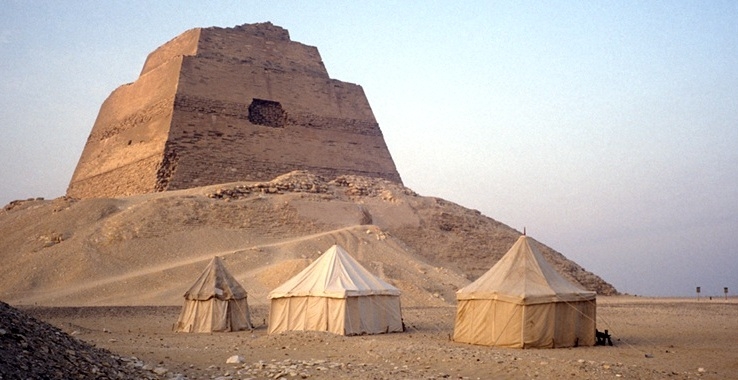
The Meidum Pyramid is one of Egypt's most fascinating and historically significant pyramids. Located near the town of Meidum, south of Cairo, it represents a transitional phase in pyramid construction, bridging the architectural evolution from stepped pyramids to the smooth-sided pyramids of the Fourth Dynasty. Built during the reign of Pharaoh Sneferu around 2600 BCE, this pyramid reflects both the ambition and the engineering experimentation of early Old Kingdom rulers.
Unlike the more famous pyramids of Giza, the Meidum Pyramid is less intact, with much of its outer casing collapsed over the millennia. Despite its partially ruined state, it provides critical insights into the development of ancient Egyptian architecture, construction techniques, and royal mortuary practices. Archaeologists and historians continue to study it to understand how pyramid building evolved from stepped forms to true geometric precision.
The Meidum Pyramid is also significant for its role in Egyptian cultural heritage. It stands as a symbol of innovation, reflecting the drive of ancient Egyptians to achieve architectural perfection and eternal legacy through monumental structures.
Historical Background
The Meidum Pyramid is attributed to Pharaoh Sneferu, the first ruler of Egypt's Fourth Dynasty, who reigned circa 2613–2589 BCE. Sneferu is renowned for his architectural experiments, aiming to perfect the pyramid design. The Meidum Pyramid initially began as a step pyramid, following the model established by Djoser’s Step Pyramid at Saqqara. Later, it was transformed into a true pyramid by adding outer casing stones to fill the steps and create smooth sides.
Historians suggest that the Meidum Pyramid may have served as a testing ground for construction techniques that would later be applied at Dahshur, where Sneferu built the Bent Pyramid and the Red Pyramid. The collapse of its outer casing, possibly due to structural miscalculations, makes it an invaluable case study for understanding the challenges faced by ancient engineers.
During its construction, the pyramid also functioned as a mortuary complex. Surrounding the pyramid, archaeologists have found evidence of smaller subsidiary pyramids, temples, and tombs for officials. These elements highlight the pyramid's dual purpose as both a tomb and a ceremonial complex.
Architecture and Design
The Meidum Pyramid is distinguished by its unique architectural evolution. Initially, it was a step pyramid, possibly with seven or eight layers. The transition to a smooth-sided pyramid involved filling the steps with limestone casing, creating what was intended to be a perfectly geometric pyramid. Unfortunately, the outer layers eventually collapsed, leaving the core steps exposed and giving it a precarious appearance today.
The base of the pyramid measures approximately 144 meters on each side, and its original height is estimated to have been around 125 meters. The collapse of the outer casing has significantly altered its profile, making it appear narrower and giving it a somewhat “tapered” look. Despite this, the pyramid remains one of the tallest structures of its era, illustrating the ambition of Sneferu’s reign.
The internal structure consists of a central burial chamber, though much of the interior has been looted or destroyed over the centuries. Archaeologists have identified corridors and passageways leading to the burial chamber, consistent with other Old Kingdom pyramid designs. The pyramid’s core construction used large limestone blocks, while the outer casing was made from finer, smoother stones, likely quarried nearby.
Archaeological Discoveries
Excavations at the Meidum Pyramid have uncovered numerous artifacts and structural elements that shed light on its history. Archaeologists have found remnants of smaller subsidiary pyramids, believed to be tombs for queens or high-ranking officials. These smaller pyramids are aligned symmetrically around the main pyramid, emphasizing the planned layout of the complex.
Additionally, fragments of statues, pottery, and inscriptions have been discovered, providing evidence of the ceremonial and religious activities conducted at the site. Although the burial chamber itself has yielded few intact artifacts due to looting, the surrounding area continues to offer valuable insights into Old Kingdom funerary practices.
The collapsed outer casing of the Meidum Pyramid has also offered archaeologists a unique opportunity to study ancient Egyptian construction techniques. By examining the core structure and remnants of the outer casing, researchers have learned about the methods used to transport, cut, and position massive limestone blocks, revealing both the ingenuity and the limitations of early pyramid engineering.
Cultural and Historical Significance
The Meidum Pyramid holds great cultural significance as a bridge between two eras of Egyptian architecture. It illustrates the transition from step pyramids, such as Djoser’s Pyramid, to smooth-sided pyramids, like those at Giza. This evolution reflects both technical experimentation and religious symbolism, as the pyramid’s shape was intended to represent the rays of the sun and facilitate the pharaoh’s journey to the afterlife.
The pyramid also embodies the ambition and authority of Pharaoh Sneferu, who sought to create lasting monuments to his reign. By studying the Meidum Pyramid, historians gain insights into the political, religious, and social dynamics of the Old Kingdom. The complex surrounding the pyramid highlights the importance of funerary rituals and the role of the king as both a religious and political leader.