
Edfu Temple
Introduction
The Temple of Edfu is one of the most impressive and best-preserved temples of ancient Egypt, representing a remarkable example of religious devotion, architectural mastery, and political ideology during the Ptolemaic period. Located on the west bank of the Nile between Luxor and Aswan, the temple was dedicated to Horus, the falcon-headed god associated with kingship, protection, and the triumph of order over chaos. Unlike many ancient Egyptian temples that survive only in ruins, the Temple of Edfu remains largely intact, offering modern scholars and visitors a rare opportunity to experience an ancient sanctuary almost as it originally appeared. Through its monumental design, detailed inscriptions, and rich symbolic decoration, the temple provides invaluable insight into the beliefs and rituals of late ancient Egyptian civilization.
Historical Background and Construction
Construction of the Temple of Edfu began in 237 BCE during the reign of Ptolemy III Euergetes and was completed in 57 BCE under Ptolemy XII Auletes. This long construction period reflects the complexity of the structure and the continued support of the Ptolemaic dynasty for traditional Egyptian religion. Although the Ptolemies were of Macedonian Greek origin, they ruled Egypt as pharaohs and adopted ancient religious customs to legitimize their authority. By building temples in the traditional Egyptian style and dedicating them to native gods, the Ptolemies reinforced their role as rightful rulers chosen by the gods.
The site of Edfu had been sacred long before the construction of the present temple. Earlier shrines and temples existed on the same location, emphasizing the continuity of worship at Edfu from prehistoric times through the Greco-Roman period. This continuity was essential in Egyptian belief, as sacred spaces were considered eternal and closely connected to the divine order of the universe.
Religious Significance of Horus of Edfu
Horus of Edfu, also known as Horus of Behdet, was one of the most important deities in ancient Egyptian religion. He symbolized kingship, protection, and divine justice. According to Egyptian mythology, Edfu was the place where Horus defeated his uncle Seth in a legendary battle that avenged the murder of Osiris and restored cosmic balance. This myth represents the eternal struggle between order (maat) and chaos (isfet), a central theme in Egyptian religious thought.
The Temple of Edfu was not only a place of worship but also a sacred stage where this myth was ritually reenacted. Reliefs and inscriptions throughout the temple depict scenes of Horus battling Seth, often shown as a hippopotamus or other chaotic creature. These symbolic representations reinforced the idea that the temple played an active role in maintaining cosmic harmony through ritual performance.
Architectural Layout and Design
The Temple of Edfu follows the traditional axial layout of ancient Egyptian temples, designed to guide worshippers from the outer, more public spaces toward the increasingly sacred inner sanctuary. This progression reflects the Egyptian concept of spiritual purification and closeness to the divine.
The Pylon
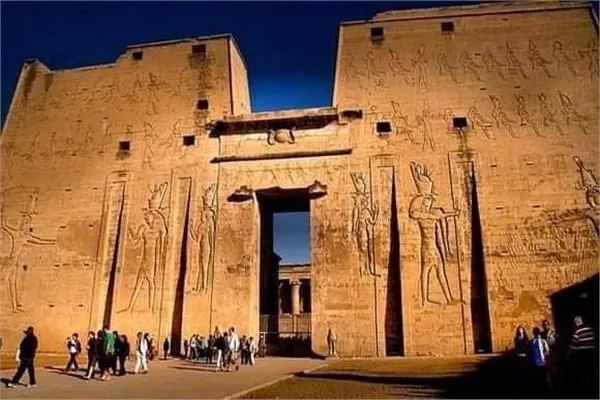
The entrance to the temple is marked by a massive pylon rising approximately 36 meters high, making it one of the tallest temple pylons in Egypt. The pylon is decorated with large reliefs showing the king smiting his enemies in the presence of Horus, a symbolic image emphasizing royal power and divine support. These scenes were not intended as historical records but as ideological statements reinforcing the pharaoh’s role as defender of order and protector of Egypt.
The Open Courtyard
Beyond the pylon lies a spacious open courtyard surrounded by colonnades. This area was accessible to the general public during festivals and ceremonies. The walls of the courtyard are covered with reliefs depicting offering scenes, royal rituals, and priestly processions. The columns are topped with floral capitals inspired by papyrus, lotus, and palm plants, symbolizing fertility, renewal, and the life-giving power of the Nile.
The Hypostyle Hall
The hypostyle hall marks a transition from the bright, open courtyard to the darker, more mysterious interior of the temple. Supported by massive columns, the hall creates a dramatic atmosphere of light and shadow that enhanced the sense of sacredness. The walls are densely inscribed with religious texts, hymns, and ritual instructions, providing detailed information about temple ceremonies and priestly responsibilities.
The Sanctuary and Inner Chambers
At the heart of the Temple of Edfu lies the sanctuary, the most sacred space in the complex. This chamber once housed the cult statue of Horus, which was believed to be the physical manifestation of the god on earth. Access to the sanctuary was strictly limited to high-ranking priests and the pharaoh himself.
Within the sanctuary stands a granite shrine dating back to the reign of Nectanebo II of the 30th Dynasty. The inclusion of this older shrine demonstrates the Egyptian practice of preserving and reusing sacred objects to emphasize religious continuity and divine permanence.
Surrounding the sanctuary are numerous chapels and chambers, each serving a specific ritual function. These include storerooms for sacred equipment, chambers for preparing offerings, and chapels dedicated to associated deities such as Hathor of Dendera, the divine consort of Horus.
Festivals and Rituals
One of the most important religious events associated with the Temple of Edfu was the annual “Sacred Marriage” festival between Horus and Hathor. During this celebration, the cult statue of Hathor was transported from her temple at Dendera to Edfu by boat along the Nile. The reunion of the two deities symbolized fertility, renewal, and cosmic harmony.
The festival involved elaborate processions, music, dancing, and offerings, and it played a crucial role in reinforcing the relationship between the gods, the king, and the people. Such festivals transformed the temple into a center of communal celebration and religious devotion.
Inscriptions and Religious Texts
The inscriptions at Edfu Temple are among its most valuable features. Written in hieroglyphs, they preserve a vast collection of religious texts, myths, hymns, and ritual instructions known collectively as the “Edfu Texts.” These texts provide detailed accounts of creation myths, temple foundation rituals, and the theological significance of sacred spaces.
The inscriptions reveal that the temple was considered a microcosm of the universe, representing the primeval mound that emerged from the waters of chaos at the beginning of creation. Through ritual performance, priests symbolically reenacted the creation of the world, ensuring the continued stability of the cosmos.
Artistic Style and Symbolism
The reliefs and carvings of the Temple of Edfu display a high level of artistic refinement and precision. Despite being constructed during the Hellenistic period, the temple’s art follows traditional Egyptian conventions with little influence from Greek styles. Figures are depicted in idealized proportions, and scenes are arranged according to strict symbolic rules.
This artistic conservatism was intentional, as Egyptians believed that maintaining traditional forms was essential for the effectiveness of religious rituals. The consistent use of established artistic conventions ensured that the temple functioned correctly as a sacred space.
Economic and Administrative Role
In addition to its religious significance, the Temple of Edfu played an important economic and administrative role. Like other major temples, it owned large agricultural estates and employed a significant number of priests, craftsmen, and laborers. The temple functioned as a center of local authority, controlling resources and redistributing wealth through offerings, festivals, and charitable activities.
These economic functions reinforced the temple’s political importance and strengthened the connection between religion and state power during the Ptolemaic period.
Discovery and Modern Importance
Over time, the Temple of Edfu was gradually buried under layers of sand, Nile silt, and debris from later settlements. By the medieval period, only the upper sections of the pylons were visible. In the nineteenth century, systematic excavations led by French Egyptologist Auguste Mariette revealed the temple in its remarkably preserved state.
Today, the Temple of Edfu is one of Egypt’s most important archaeological sites and a major tourist attraction. Its exceptional preservation makes it a key reference point for understanding ancient Egyptian temple architecture and religious practice.
Conclusion
The Temple of Edfu stands as a monumental testament to the endurance of ancient Egyptian religious tradition. Built during the Ptolemaic period, it shows how deeply rooted Egyptian beliefs remained despite political change and foreign rule. Through its grand architecture, rich inscriptions, and symbolic imagery, the temple offers unparalleled insight into the spiritual, cultural, and political life of ancient Egypt. Let’s discover the beauty of Edfu Temple through our Egypt tours packages, experiencing its power, artistry, and history firsthand as one of the best-preserved temples in the country