
The Lighthouse of Alexandria: Exploring the Legacy of the Ancient World’s Guiding Star
The Lighthouse of Alexandria, also known as the Pharos of Alexandria, stands as one of the most iconic engineering achievements of the ancient world. Built more than two thousand years ago on the island of Pharos overlooking the Mediterranean Sea, the lighthouse was more than a navigational aid—it was a monumental expression of the power, ambition, and innovation that defined the Hellenistic age.
Although the original structure no longer stands, its legacy continues to shape Alexandria’s identity, inspire architectural wonders, and captivate the imagination of travelers from across the world. Visiting Alexandria today offers a chance to walk in the shadow of this lost wonder, explore its story, and discover the remnants and reinterpretations that preserve its memory.
This detailed guide explores the history, architecture, cultural significance, myths, reconstruction efforts, and modern attractions connected to the Lighthouse of Alexandria—offering an immersive journey into one of humanity’s grandest achievements.
The Birth of a Wonder: Historical Background
The Lighthouse of Alexandria was built during the reign of Ptolemy I Soter, around the late 3rd century BC, and completed under the rule of his son, Ptolemy II Philadelphus. At this time, Alexandria was a thriving center of philosophy, commerce, and scientific inquiry—a city founded by Alexander the Great and destined to become one of the Mediterranean’s greatest metropolises.
Located on the small island of Pharos, the lighthouse served a vital purpose. Alexandria’s harbor, though strategically located, was notoriously difficult to navigate due to sandbanks, rocks, and shifting currents. Ships carrying goods from Greece, Asia Minor, Arabia, and North Africa depended on a visual beacon to safely reach the city’s bustling port.
The lighthouse fulfilled this need while also showcasing the wealth and technological sophistication of the Ptolemaic dynasty. Its brilliance and scale made it one of the Seven Wonders of the Ancient World, alongside the Great Pyramid of Giza.
Architectural Marvel: Design and Construction
The Lighthouse of Alexandria was designed by the Greek architect Sostratus of Cnidus, though inscriptions suggest he cleverly carved his name beneath plaster bearing the name of the ruling king—ensuring his own legacy would outlive political changes.
The structure is believed to have been between 100 and 130 meters tall, making it one of the tallest man-made structures on Earth for centuries. No ancient lighthouse matched its scale, engineering complexity, or artistic elegance.
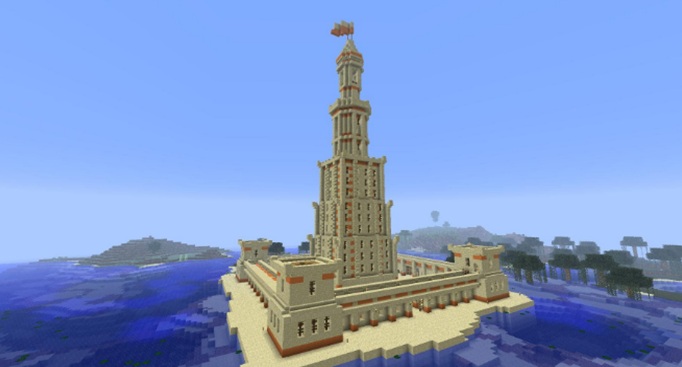
The design consisted of three main tiers:
1. The Square Base
The lowest tier was a massive square platform built from limestone blocks. This level housed storage rooms, living quarters for workers, and ramps for transporting materials up the tower.
Strong and wide, it provided stability against earthquakes and strong Mediterranean winds.
2. The Octagonal Middle Section
Above the base rose an eight-sided tower, narrower but more refined in architectural style. This section likely featured windows, viewing balconies, and decorative friezes. The octagonal structure helped distribute weight evenly and contributed to the lighthouse’s iconic silhouette.
3. The Cylindrical Upper Tower
The uppermost tier was cylindrical and held the lantern chamber—the glowing heart of the lighthouse. According to ancient sources, a giant bronze mirror stood inside the chamber, reflecting sunlight during the day and firelight at night. Some historians even suggest the mirror may have been capable of focusing light beams toward distant ships.
At the very top stood a statue—traditionally believed to represent Zeus, Poseidon, or Alexander the Great, symbolizing Alexandria’s divine protection.
Engineering Genius: How the Lighthouse Worked
The Lighthouse of Alexandria functioned as both a daytime and nighttime beacon.
Daytime Navigation
During sunlight hours, the tower’s gleaming white limestone, polished façade, and elevated position made it visible from miles out at sea. The massive bronze mirror is thought to have intensified sunlight, flashing signals to approaching sailors.
Nighttime Illumination
At night, a large fire burned within the lantern chamber. Workers kept the fire blazing constantly, carrying fuel up ramps and stairways. The reflective mirror magnified the glow, turning the lighthouse into a blazing star above the Mediterranean.
This dual-use system was revolutionary and set the standard for lighthouse design in centuries to come.
Symbolism: A Beacon of Power, Culture, and Identity
The Lighthouse of Alexandria was much more than a maritime structure—it was a symbol of Alexandria’s cosmopolitan spirit.
A Fusion of Cultures
The design drew from Greek architectural styles but used Egyptian materials and reflected the city’s multicultural identity. Alexandria, at the time, was a melting pot of:
-
Egyptian traditions
-
Greek philosophy
-
Roman trade
-
Eastern influences
The lighthouse represented this blending, serving as a visual embodiment of global exchange and cultural dialogue.
A Symbol of Divine Protection
Sailors often prayed to sea gods for safety, and the lighthouse’s rooftop statue reinforced beliefs that divine forces guarded the harbor. Its towering presence offered psychological comfort to those navigating dangerous waters.
An Icon of Technological Mastery
The structure boldly demonstrated humanity’s ability to harness knowledge and skill to overcome natural challenges, marking the peak of the Hellenistic world's engineering achievements.
Daily Life on Pharos Island
The lighthouse was part of a larger complex that included:
-
Workshops
-
Barracks for guards
-
Homes for lighthouse keepers
-
Small temples
-
Storage facilities
The island buzzed with daily activity. Workers tended to the fire, polished surfaces, repaired storm damage, and managed the constant flow of visitors—from merchants to philosophers.
Pharos Island also served as an unofficial gathering place for sea captains, traders, and travelers exchanging stories, maps, and news—a vibrant microcosm of Alexandria’s cosmopolitan spirit.
.jpg)
Earthquakes and Decline: The Fall of the Lighthouse
Although the Lighthouse of Alexandria resisted centuries of storms and invasions, its downfall came from natural forces.
Egypt lies near the Mediterranean seismic zone, and between the 10th and 14th centuries, three major earthquakes devastated the structure:
-
956 AD: First major quake damaged upper levels
-
1303 AD: A severe earthquake near Crete collapsed major parts of the tower
-
1323 AD: Another quake completed its destruction
By the late 14th century, the lighthouse had become a ruin. The Mamluk Sultan Al-Ashraf Qaitbay later used its stones to construct the Qaitbay Citadel, continuing the legacy of Pharos in a new form.
Rediscovery Beneath the Waves
In the 20th century, underwater archaeologists discovered thousands of massive stone blocks, columns, statues, and architectural fragments off the coast of Alexandria—most believed to belong to the lighthouse.
Among the discoveries:
-
Granite blocks weighing up to 70 tons
-
Statues of kings and mythological figures
-
Columns and sphinxes
-
Decorative friezes and architectural fragments
These underwater ruins hold tremendous archaeological value and reveal the scale and artistry of the original structure.
Modern Interpretations and Visitor Attractions
While the original lighthouse no longer stands, its legacy lives on in Alexandria through several fascinating sites:
1. Qaitbay Citadel
Located exactly where the lighthouse once stood, this 15th-century fortress offers panoramic sea views and serves as a symbolic successor to Pharos.
2. Alexandria’s Underwater Museum Project
Egypt is developing plans for an underwater archaeological park, allowing visitors to explore the submerged ruins through diving tours or glass tunnels.
3. Bibliotheca Alexandrina
The modern Library of Alexandria includes architectural elements inspired by ancient Alexandria, capturing the city’s historical spirit.
4. Models and Exhibits
Several museums in Egypt and around the world display reconstructions of the lighthouse, offering a sense of its imposing grandeur.
What Visiting the Site Feels Like Today
Standing on the shores of the Eastern Harbor where the lighthouse once rose offers a powerful, almost poetic experience.
Visitors often describe:
-
Sea winds filled with the scent of salt
-
The rhythmic crash of waves against the citadel walls
-
The feeling of standing where ancient sailors once arrived from distant worlds
-
A quiet sense of wonder imagining the beacon that once guided ships home
It is a place where the past lingers like a whisper—where Alexandrian history seems to rise with the tide.
Why the Lighthouse of Alexandria Still Matters
Despite its physical disappearance, the Lighthouse of Alexandria continues to inspire:
Engineering
Its design influenced medieval Islamic minarets and modern lighthouse construction.
Art and Literature
The lighthouse appears in ancient texts, medieval writings, and modern fiction.
Cultural Identity
It serves as a symbol of Alexandria’s enduring place in world history.
Tourism
Visitors continue to flock to the site, drawn by its history and its aura of mystery.
Legacy and Future: Dreams of Rebuilding
There have been modern proposals to reconstruct the lighthouse, either as:
-
A historical replica
-
A functional lighthouse
-
A modern museum
-
A mixed-use cultural center
While plans remain under discussion, the idea reflects how deeply the lighthouse continues to resonate in public imagination.
Final Thoughts: A Wonder That Still Shines
The Lighthouse of Alexandria may no longer stand in stone, but its light continues to shine through history, legend, and the enduring spirit of Alexandria itself. It represents human ambition—our desire to explore, create, innovate, and connect.
Its story invites travelers to imagine a world where science, art, and culture flourished side by side in one of the greatest cities ever built.