
Catacombs of Kom El Shoqafa: Exploring Alexandria’s Subterranean Wonder
The Catacombs of Kom El Shoqafa—one of Alexandria’s most mysterious and captivating archaeological treasures—offer a fascinating journey into Egypt’s richly layered past. Hidden beneath the bustling modern city, these ancient burial chambers combine Egyptian, Greek, and Roman artistic traditions in a way found nowhere else in the world. For travelers seeking history, mystery, and distinctive cultural fusion, the Catacombs stand as one of Alexandria’s must-see attractions.
Often referred to as one of the “Seven Wonders of the Middle Ages,” the Catacombs of Kom El Shoqafa are far more than a burial site. They are a striking testament to a cosmopolitan era in Alexandria, when three cultures interacted and blended seamlessly, shaping art, religion, and daily life. Exploring this site means walking into the heart of Alexandria’s multi-layered identity—an identity formed through centuries of trade, migration, philosophy, and imperial rule.
A Journey Through Time: History of Kom El Shoqafa
The Catacombs date back to the 2nd century AD, during the Roman period in Egypt. Scholars believe that the complex was commissioned by a wealthy Alexandrian family who embraced Roman funeral traditions while still holding on to older Egyptian beliefs. This mixture of practices created a burial site unlike any other in the ancient world.
The name “Kom El Shoqafa” translates to “Mound of Shards,” referring to the broken pottery fragments discovered in the area. These shards were believed to be remnants of vessels that visitors used to bring food and drink offerings for the deceased. After using the vessels, they broke them to avoid the bad luck associated with bringing death-related items back home.
For centuries, the Catacombs remained unknown, buried under layers of earth. In 1900, the site was accidentally rediscovered when a donkey reportedly fell into a shaft, revealing the underground world beneath. This unexpected discovery became one of the most significant archaeological finds of the 20th century, opening new windows into Alexandria’s ancient multicultural society.
Descending into the Depths: Structure of the Catacombs
The Catacombs are not merely a simple tomb. They form a three-level complex, featuring chambers, passageways, statues, and remarkable reliefs—all carved below ground. Each descending level takes visitors deeper in time, both physically and historically.
1. The Spiral Staircase
Your journey begins with the iconic helical staircase, designed ingeniously around a central shaft. In ancient times, ropes and pulleys lowered bodies down the shaft for burial. As visitors descend step by step, the temperature grows cooler, and the air becomes unmistakably still—enhancing the sense of entering an entirely different world beneath the city.
2. The Triclinium (Funerary Dining Hall)
At the lower level lies the triclinium, a chamber where families gathered for ritual funerary meals. This Roman-inspired tradition reflects the blending of cultures common in Greco-Roman Alexandria. Stone benches line the walls, and the room’s size reflects its role as a gathering place—a communal space meant for remembrance and honoring the dead.
3. The Main Burial Chamber
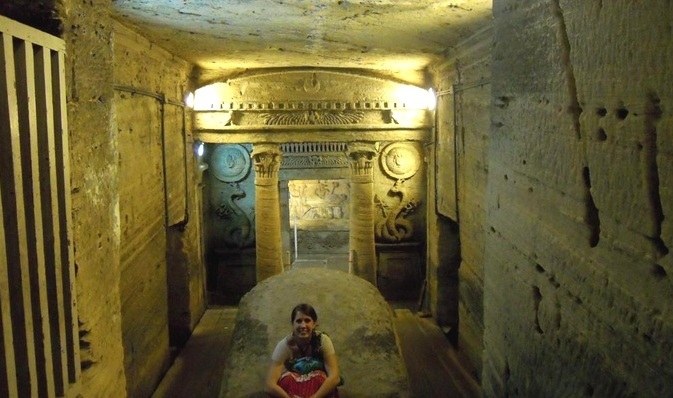
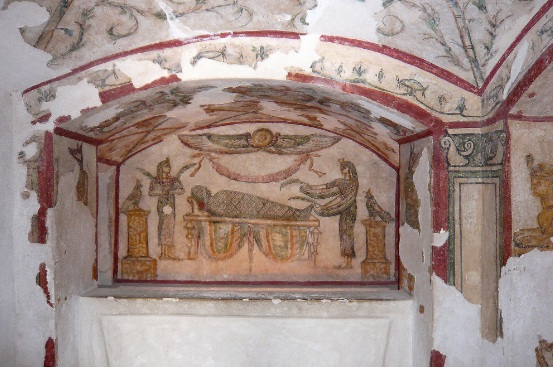
The heart of the complex is the Principal Tomb, one of the most iconic examples of artistic fusion in the ancient Mediterranean. Here, Egyptian deities appear wearing Roman military attire, and Roman architectural motifs blend seamlessly with pharaonic symbolism. Highlights include:
-
Anubis, god of mummification, depicted in Roman armor
-
Sobek and Horus carved into niches
-
Medusa heads serving as protective symbols
-
Lotus flowers, serpents, and sun disks reflecting ancient Egyptian beliefs
This chamber stands as a powerful visual statement: a world where cultures interacted not through conflict but through creative synthesis.
4. Side Niches and Loculi
Surrounding the central chamber are numerous loculi—rectangular openings carved into the walls where bodies were placed. These openings once held sarcophagi and mummified remains, though most have been removed for preservation.
Some side chambers also include human figures in Greek-style poses, demonstrating how Alexandria’s residents embraced artistic trends from across the Mediterranean while still honoring their ancestral customs.
Symbolism and Art: A Blend of Worlds
The Catacombs of Kom El Shoqafa stand out for their extraordinary syncretic art style, where Egyptian, Greek, and Roman motifs merge harmoniously. This fusion was a hallmark of Alexandria, a city founded by Alexander the Great and shaped by centuries of global interaction.
Egyptian Influence
Egyptian elements reflect long-standing beliefs about the afterlife:
-
Winged sun disks symbolizing divine protection
-
Depictions of Anubis and Osiris
-
Traditional lotus and papyrus carvings
-
Hieroglyphic-style decorative patterns
These features echo the spiritual worldview that considered death not an end but a transition.
Greek Influence
Greek artistic culture appears in:
-
Realistic human proportion and musculature
-
Mythological figures like Medusa
-
Corinthian columns and decorative capitals
These elements connect the tomb to Alexandria’s Hellenistic golden age.

Roman Influence
Roman presence is strong through:
-
Military attire and armor
-
Helmeted deities and symbolic shields
-
The structural design of the triclinium
Rome, as the ruling power, heavily shaped life in Alexandria, yet locals adopted Roman styles while preserving their unique identity.
Kom El Shoqafa and the Spirit of Ancient Alexandria
More than a burial site, Kom El Shoqafa reflects Alexandria’s essence during the Roman era—a city where intellectual exchange and cultural fusion flourished. At this time, Alexandria was home to philosophers, scientists, astronomers, and artists, all contributing to its status as a thriving cosmopolitan hub.
The Catacombs provide rare, intimate insight into the daily lives, beliefs, and traditions of its residents. Rather than focusing solely on royal or elite narratives, the site represents the middle and upper-middle classes—those whose stories often go untold in grand monuments.
What to Expect When Visiting
A visit to the Catacombs of Kom El Shoqafa offers a blend of atmosphere, history, and emotion. Whether you are a history lover, cultural traveler, or photography enthusiast, this subterranean marvel promises an unforgettable experience.
Atmosphere
The cool air, dim lighting, and echoing footsteps create a sense of reverence. Many visitors describe the site as hauntingly beautiful—a place where time feels suspended.
Photography
Although the lighting is low, the reliefs, statues, and staircases provide dramatic photographic opportunities. Visitors should be prepared for underground conditions and potentially narrow spaces.
Accessibility
Because the Catacombs are underground, visitors need to navigate steps and passages. Comfortable walking shoes are recommended.
Location
The site is located in the Karmouz district of Alexandria, close to the ancient Serapeum and Pompey’s Pillar, making it easy to combine nearby sites into a single itinerary.
Tips for Travelers
To make the most of your visit, consider these practical tips:
-
Arrive early to avoid crowds and enjoy quiet moments in the chambers.
-
Bring water, especially on warm days.
-
Hire a local guide for deeper understanding of the symbolism and artwork.
-
Wear comfortable shoes suitable for stairs and uneven surfaces.
-
Explore nearby attractions, including Pompey’s Pillar, the Roman Amphitheatre, and the Serapeum.
Cultural Significance Today
The Catacombs remain a symbol of Alexandria’s identity—a city defined by diversity and cross-cultural interaction. They serve as a reminder of Egypt’s complex history, where different civilizations left their mark over millennia.
Today, the site is protected as an important archaeological monument and continues to attract researchers, historians, and tourists from around the world.
Why Kom El Shoqafa Is a Must-See Destination
Travelers seeking deeper insight into Egypt’s past will find that Kom El Shoqafa offers something rare: a physical space where the borders between civilizations blur beautifully. It is:
-
One of the most well-preserved Roman-era burial sites in Egypt
-
A masterpiece of artistic fusion
-
A breathtaking underground architectural achievement
-
A profound window into Alexandria’s multicultural soul
Visiting the Catacombs reveals a chapter of history that textbooks cannot capture—one shaped by human creativity, belief, and cultural harmony.
Final Thoughts: A Timeless Journey Beneath Alexandria
The Catacombs of Kom El Shoqafa invite travelers to step beyond the ordinary and descend into a world where ancient Egyptians, Greeks, and Romans coexist in extraordinary harmony. This unique archaeological treasure reflects the essence of Alexandria as a world crossroads—bridging continents, ideas, and centuries.
From the spiral staircase to the stunning carvings that decorate the burial chambers, every corner of Kom El Shoqafa tells a story. It is a place where art and architecture speak a universal language, reminding us of a time when diverse cultures lived, worked, and created side by side.